

SLIM MVP: Multicluster Customer Remediation with AI Agents
This post walks through a multicluster customer-remediation scenario built on SLIM. A customer cluster stays private, a cloud-hosted troubleshooting agent stays reachable, and operators and automation work across that boundary without exposing every service involved.
The demo combines A2A for agent-to-agent interaction, MCP for tool access into Kubernetes and Jira, and SPIRE for workload identity. The result is a system where a private cluster can be onboarded with outbound connectivity only, queried from Copilot through an A2A skill, and monitored continuously by a health-check job that can open a Jira issue automatically when something breaks.
The problem with cross-cluster remediation
Customer remediation flows usually break down at the network boundary.
In a typical deployment, some services run in a public cloud cluster while the systems they need to inspect or repair live inside a private datacenter or a customer-managed Kubernetes cluster. Traditional approaches solve that problem with a mix of public ingress endpoints, reverse proxies, VPN access, and hand-maintained routing rules. That model is expensive to operate and expands the attack surface every time a new service needs to be reached.
How SLIM changes the model
SLIM moves the system from “connect to a host and port” to “talk to a named service over a secure overlay”.
- Services connect outbound to a local SLIM node instead of listening on a public port.
- The customer cluster only needs the address of the controller and a valid identity token to join the topology.
- SLIM nodes forward traffic over gRPC and TLS, while MLS protects the payload itself end-to-end.
- Agents and tools can be written in different languages and still share the same transport layer.
At a high level, the demo topology looks like this:
graph LR
    subgraph CUSTOMER[Customer Cluster]
        KMCP[k8s MCP Server] --> CSN[SLIM Node]
        AMCP[Atlassian MCP Server] --> CSN
    end

    subgraph CLOUD[Cloud Cluster]
        SN[SLIM Node]
        CTRL[SLIM Controller]
        K8S[k8s Troubleshooting Agent\nA2A server + MCP client]
        HCJ[Health Check Job\nA2A client]
        SN -.-> CTRL
        K8S --> SN
        HCJ --> SN
    end

    COPILOT[IT Ops Laptop / Copilot\nA2A client skill] --> SN
    CSN <--> SN
    CSN -.-> CTRL

    style CUSTOMER fill:#e8eefb,stroke:#0251af,color:#1c1e21
    style CLOUD fill:#eff3fc,stroke:#0251af,color:#1c1e21
    style SN fill:#0251af,color:#f3f6fd
    style CSN fill:#0251af,color:#f3f6fd
    style CTRL fill:#023a7a,color:#f3f6fd
    style K8S fill:#cfe1fb,color:#1c1e21
    style HCJ fill:#cfe1fb,color:#1c1e21
    style KMCP fill:#cfe1fb,color:#1c1e21
    style AMCP fill:#cfe1fb,color:#1c1e21
    style COPILOT fill:#cfe1fb,color:#1c1e21
The cloud side hosts the shared control plane and the troubleshooting logic. The customer side keeps its tools and data local. SLIM bridges the two without turning the customer cluster into a publicly exposed API surface.
What the demo shows
The demo focuses on two concrete workflows.
1. Human interaction over A2A and MCP
An IT operator uses Copilot with an A2A CLI skill to ask questions about the customer cluster, such as the list of pods running in a namespace or the root cause of a failure. The request travels over SLIM to a cloud-hosted Kubernetes troubleshooting agent. That agent then uses MCP, again over SLIM, to reach the customer-side Kubernetes MCP server and gather the data it needs before sending an A2A response back to the operator.
2. Automated health checks and Jira issue creation
A health-check job in the cloud periodically asks the troubleshooting agent for
the status of the customer cluster. If a pod enters an ImagePullBackOff
state, the agent investigates, determines the issue, and calls the customer’s
Atlassian MCP server to create a Jira issue automatically.
The second flow is the most important operationally because it shows that the same connectivity model supports both observability and action.
sequenceDiagram
    participant HCJ as Health Check Job
    participant SNc as SLIM Node (cloud)
    participant Agent as k8s Agent
    participant SNp as SLIM Node (customer)
    participant Proxy as MCP Proxy
    participant KMCP as k8s MCP Server
    participant AMCP as Atlassian MCP Server

    HCJ->>SNc: A2A request: cluster status
    SNc->>Agent: route request
    Agent->>SNc: MCP request for pod status
    SNc->>SNp: route to customer cluster
    SNp->>Proxy: forward request
    Proxy->>KMCP: inspect workload state
    KMCP-->>Proxy: ImagePullBackOff detected
    Proxy-->>SNp: MCP response
    SNp-->>SNc: route response back
    SNc-->>Agent: deliver result
    Agent->>SNc: MCP request to create Jira issue
    SNc->>SNp: route to customer cluster
    SNp->>Proxy: forward request
    Proxy->>AMCP: create issue in Jira
    AMCP-->>Proxy: issue created
    Proxy-->>SNp: MCP response
    SNp-->>SNc: route response back
    SNc-->>Agent: deliver confirmation
    Agent-->>SNc: A2A response
    SNc-->>HCJ: health check completed with remediation ticket
Zero-touch onboarding matters
Customer onboarding has to be nearly frictionless.
The customer only needs:
- The public address of the SLIM controller.
- A valid authentication token, issued through SPIRE-backed identity.
From there, the customer-side SLIM node connects outbound, registers with the controller, and receives routing configuration automatically. No VPN bootstrap, no manual route installation, and no per-service ingress setup.
The configuration surface is intentionally small:
slim:
  services:
    slim/0:
      controller:
        clients:
          - endpoint: "https://slim-control-plane.example:443"
            auth:
              type: spire
              jwt_audiences:
                - "slim"
The controller views before and after a new cluster joins illustrate this.


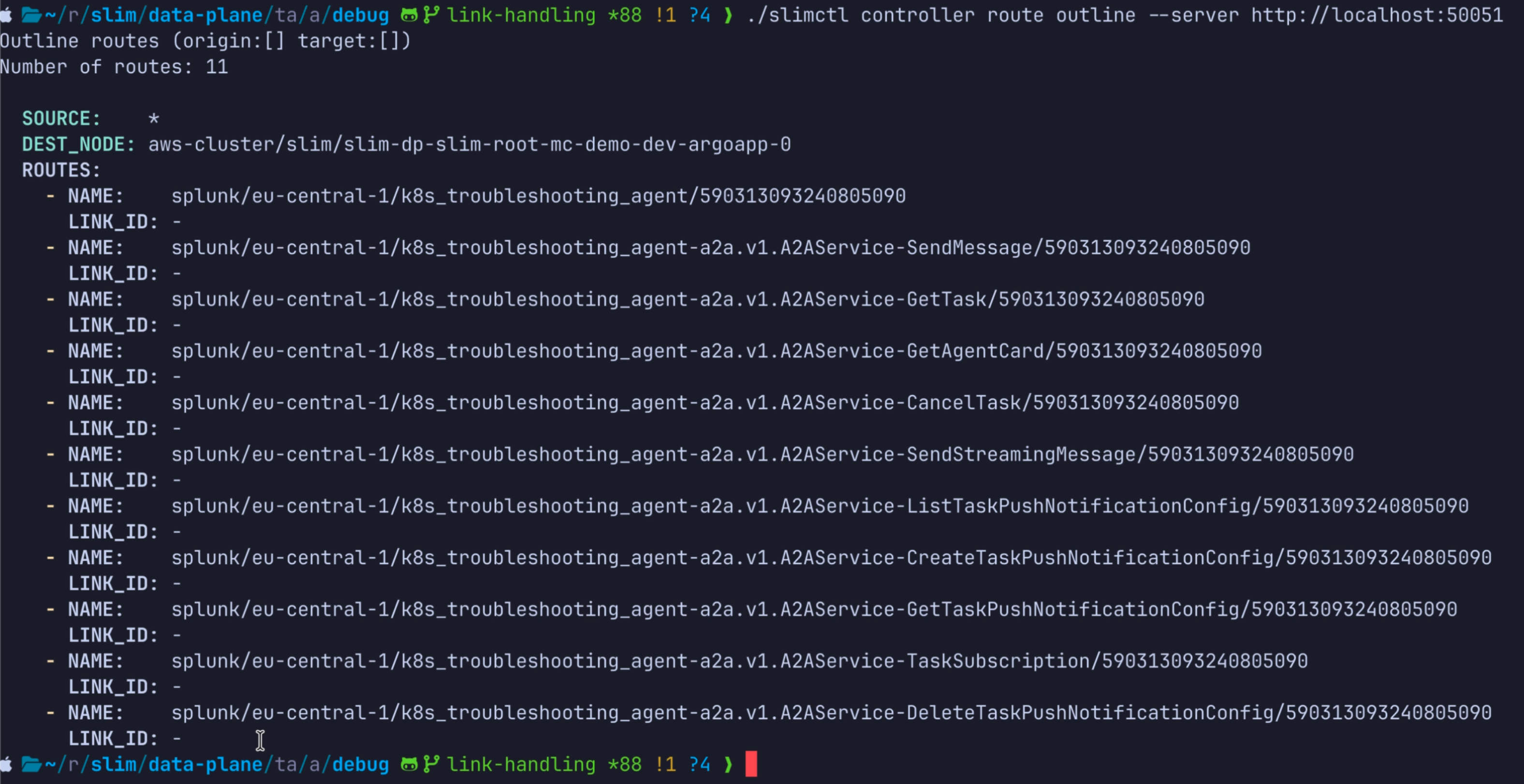
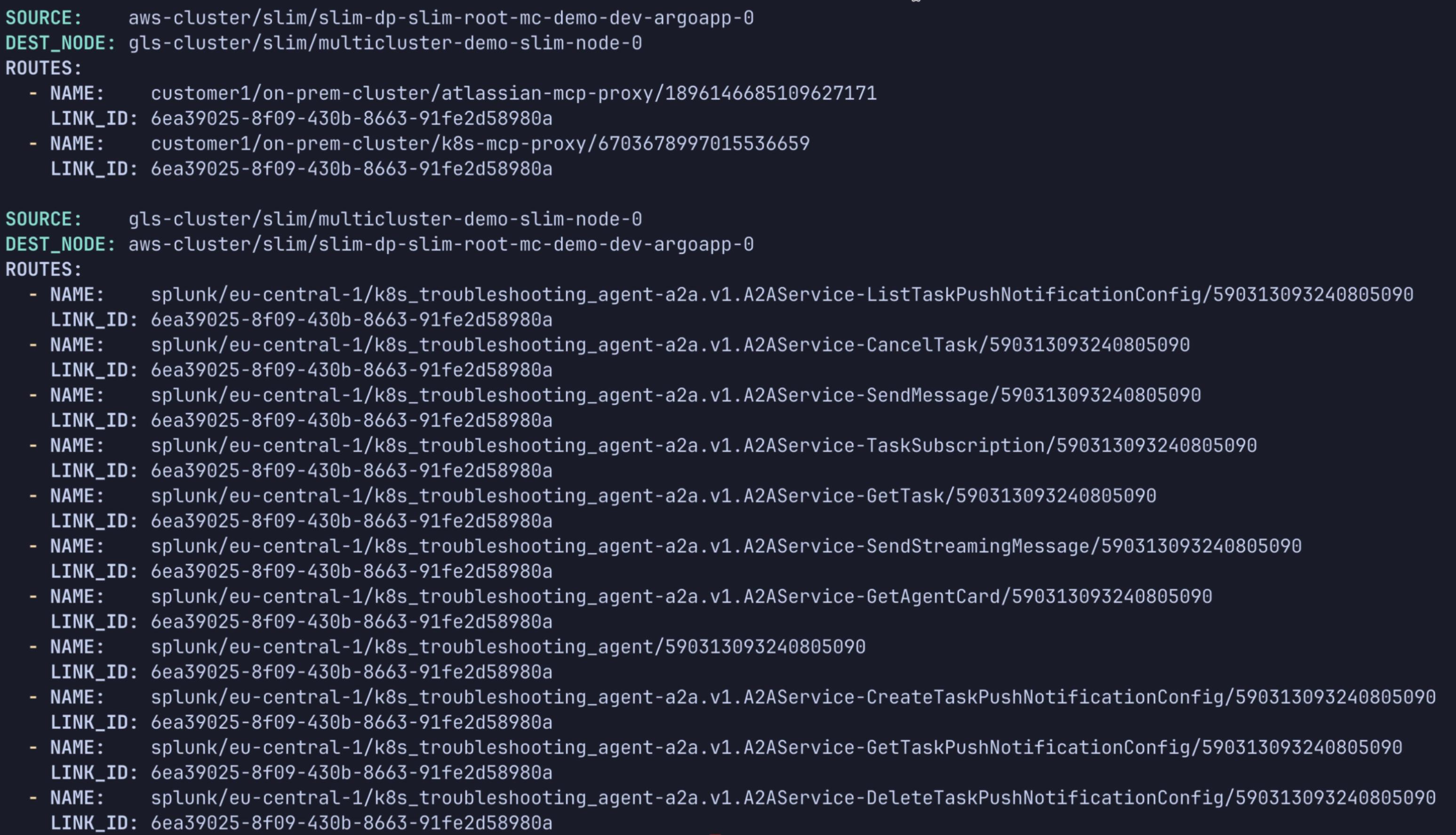
The service naming convention reinforces that model. Cloud-hosted services use
names such as splunk/eu-central-1/k8s_troubleshooting_agent, while
customer-side services use names such as
customer-1/on-prem-cluster/k8s-mcp-proxy. That structure keeps routing and
ownership explicit without leaking network topology into application code.
Why SLIM fits AI-assisted operations
The hard part of multicluster agent systems is not agent logic — it is secure communication across messy enterprise networks.
The demo grounds that claim in a real operations flow:
- A human asking Copilot for live cluster state.
- An A2A request reaching a cloud-hosted troubleshooting agent.
- MCP calls crossing into the private customer cluster over SLIM.
- An automated Jira issue being created when the health-check job finds a workload failure.
That makes the value proposition concrete.
- SLIM gives you one transport layer for A2A, MCP, and other protocols.
- Customer environments remain private and outbound-only.
- Operators and automation both use the same connectivity model.
- MLS keeps payloads encrypted even when traffic traverses shared routing infrastructure.
- SPIRE gives every participant workload identity without static secrets.
Slides and demo assets
The full presentation is embedded below.
If you prefer to open the deck directly, use the interactive Slidev version.
Closing thoughts
SLIM ties multicluster communication to an operational outcome: onboarding a customer cluster, diagnosing issues through an agent interface, and filing remediation tickets automatically without dismantling the customer’s network boundaries.
That is the core promise of SLIM in this space. It does not just make multicluster AI agents possible. It makes them practical to deploy in the kinds of private, policy-heavy environments where they are actually needed.